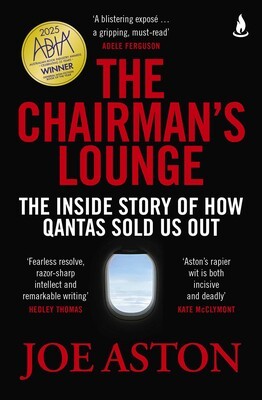
 The Chairman's Lounge
Simon & Schuster Australia
2024
359
This is the story of the downfall of an Australian business hero, the destruction of an iconic Australian brand, and hubris. In a mere four years Alan Joyce when from hero status in Australia, to literally hiding out with his mother in Dublin while being hounded by the press. Truly his downfall was impressive.
However, I think it’s also another example of Welshian management ultimately failing, as seen with General Electric in The Man Who Broke Capitalism and Lights Out. This includes: publishing accounting results that while inline with the definition of the accounting standards appear to have redefined expenses in a manner convenient to management with little rationale provided; misleading customers on their refund rights at a time when those same customers were trapped at home suffering and Qantas was sitting on massive cash stockpiles; illegal union busting; and shedding large numbers of highly skilled staff which simply couldn’t be replaced in a timely manner when travel ramped back up again. That is, optimizing for this quarter’s numbers by completely ignoring the longer term impact of the decisions being made.
This quote from page 94 is particularly telling:
“Its always better to own and control your own facilities because it limits your risk when things change,” says the Australian and International Pilots Association president, Captain Tony Lucas. “The parallel I draw would be with [aircraft] maintenance. Qantas has no heavy maintenance capability for the A380 fleet in Australia so we’re beholden to maintenance facilities overseas.” Even by mid-2024, more than thirty months since the relaunch of Qantas International, “we’ve still only got six out of ten Qantas A380s flying, because we can’t get the other four through those [foreign facilities], which are fully booked”.
“When you lose control of your ability to produce things or to perform work that is fundamental to your business, that has downstream risks that I think people don’t tend to fully comprehend.”
The same is true for Qantas’ workforce in terms of qualified and current pilots, cabin crew, and licensed aircraft mechanics. These people don’t grow on trees, they take years to train and must be continually re-certified. Qantas just… stopped employing them, and now can’t source enough people for the work at hand.
The book makes a point on page 148 is another stand out moment for me:
Institutional investors are focused on index-beating returns for the companies they own. Quite inevitably, this causes them to be monomaniacally fixated on the share prices and capital returns of companies. But enslaving a company to the short-term propellants of its share price is rarely in the long-term interests of that company.
If we expect our investments to do better than the index, which is itself an average of the biggest companies in the market and therefore the ones the investors are mostly likely to own, aren’t we expecting every company to perform better than average? To a certain extent aren’t we expecting them to perform better than themselves given they are the ones the index is composed of. That seems like a mathematical failure that perhaps a well paid fund manager should be able to figure out?
This is also a story of a company in crisis — plummeting brand trust scores, accusations of unfair treatment of their most loyal customers, the failure to manage the age of the fleet and the availability of trained staff to operate that fleet, and yet somehow the entire senior management was fixated on whether this criticism reflected poorly on the CEO as a person instead of if it was true. Aston asserts this is an example of Dacher Keltner’s research that people in power suffer behavioral changes over time which make them incapable of seeing their own unethical actions, and “produce narratives of a exceptionalism about themselves because their high status requires moral justification” (page 209).
At the same time, not all of this is Joyce’s fault. This is also a story of regulatory capture and governments from both sides of politics failing to act in the best interests of the public, as well as of the media and financial analysts not bothering to verify the outlandish statements Joyce made to justify his actions. I have more sympathy here for the journalists than the others — they’ve had their staffing cut to the bone and it’s hard to do basic fact checking when you’re expected to smash out endless articles so no one notices you’re the only one left in the newsroom.
Overall this is a very readable book and I enjoyed it. It only once caused me to lie in bed thinking about corporate governance standards.